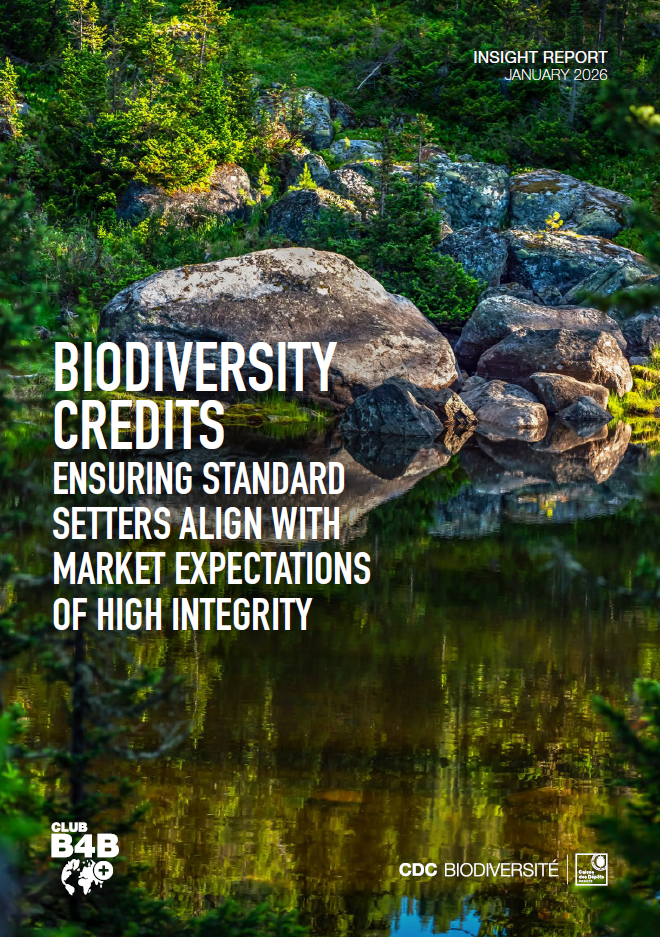
Biodiversity credits and high integrity: an assessment framework to contribute to the emergence of the market
Dossier de la MEB B4B+Club’s insight report – January 2026

Sommaire de la publication
Foreword by Marianne Haahr, Executive director, IAPB
In search of an innovative instrument to fill the biodiversity financing gap
Understanding the biodiversity credits ecosystem and how its actors interact
Evaluation grid: guiding the emergence of a high-integrity market
- Designing a grid to assess standard setters’ alignment with high integrity criteria
- Evaluation grid: criteria and scoring system
- Standard setters’ evaluation process
- Four standard setters under the microscope
Key insights from the evaluation
- Overview
- A two-tier market?
- Specific strengths and values reflected in the different standards
- Areas of alignment and differences
Limitations
Conclusion & perspectives
RÉSUMÉ
Biodiversity credits hold the potential to bridge the biodiversity financing gap, yet scaling up lies on one critical condition: market integrity.
Since the adoption of the Global Biodiversity Framework at COP15 in 2022, biodiversity credits have emerged as a potential financial instrument to mobilise private investment for biodiversity. Drawing on lessons from voluntary carbon markets, this mechanism aims at avoiding past shortcomings. However, ensuring high integrity remains challenging in an emerging market that lacks proper governance infrastructures.
Mapping the biodiversity credits ecosystem shows that standard setters occupy a central position among the actors involved. By establishing frameworks, methodologies, and issuance procedures, they currently act as de facto guarantors of credibility and integrity for the market. This raises a key question: can their “high integrity” be assessed in an objective manner?
To address this question, we developed a comprehensive evaluation framework comprising 28 criteria. Standard setters were invited to perform a self-assessment against these criteria, while CDC Biodiversité conducted an independent review based solely on publicly available information. After engaging with these organisations, our findings reveal that, despite commendable progress, none of the evaluated standard setters currently meets the threshold for full alignment with high-integrity requirements.
While the grid has its own limitations, it serves both as an assessment and an engagement tool: it highlights each standard setter’s strengths and rooms for improvement and supports continuous progress across the market.
Édito

Marianne Haahr
Executive Director, IAPB